Entered Apprentice Mason
Entered Apprentice
Study Guide
Entered Apprentice Mason Training will assist you in your study of Freemasonry...and, there is much to learn.


This E.A. Study Guide provides an easy, step-by-step learning tool to help you understand Freemasonry's biblical, historical and symbolic meanings and tenets.
Memorization of words is simply not enough. Memorization coupled with a true understanding of that which is memorized, becomes Masonic wisdom and will provide an infinite benefit to you throughout your Masonic life.
We're going to begin your Fast Track Entered Apprentice Training by discussing the working tools of the Entered Apprentice, which you see, above.....
The Working Tools of an Entered Apprentice Mason
The Entered Apprentice should always
be ready to use his (symbolic) tools. Freemasonry is not only for the lodge room but
as a primer (a book of basic rules) as to how best to live your life.
The working tools of an Entered Apprentice are the
Twenty Four Inch Gauge and the Common Gavel.
24 Inch Gauge: The
Entered Apprentice Mason is taught that by the Twenty-four Inch Gauge he should
divide his time:
Eight hours for the service of God and a distressed worthy brother;
Eight for your vocation (work), and;
Eight for refreshment and sleep.
The Common Gavel: An "Ashlar" is a stone. The Common Gavel was used by Entered Apprentice operative (real) stone masons to break the corners off of a rough stone (rough ashlar) to better craft them to the builder's purpose...to lay a true and correct foundation of a building.
Without "perfect ashlars with which to lay your personal foundation, your building cannot be laid out on the square (horizontally), nor be perfectly plumbed, upright (vertically).
Each and every foundation (whether it be an actual building, or that building not made with hands...which is You), must use both the square and the plumb (in perfect alignment with each other) or it will be viewed as shoddy work and subject to falling back down into a pile of rubble.
As an Entered Apprentice Mason, you will begin to remove these
rough edges and shape your character so as to "divest your heart and conscience
of all the vices and superfluities (excesses) of life".
First Degree Freemason Training
The training of an Entered Apprentice Mason begins within,... as all men are first prepared in their heart to be made a Freemason.
The decision must be of their own free will and accord. Each Lodge is erected to God, our Creator, the Supreme Architect of the Universe, and dedicated to the 2 Holy Saints John.
It is in God, our Creator, in whom each man must put his trust.
Q: What do Freemasons seek?
A: Light. "Light" represents knowledge. All Freemasons continually seek more knowledge.
Q: Will I learn the Masonic secrets in this Entered Apprentice Mason Study Guide?
A: No. They will be learned in the lodge in which you will be raised to the Sublime Degree of Master Mason. They are the grips, penal signs, passwords and ritual work.
Q: Is there a Penalty for an Entered Apprentice Mason Failure to Memorize the Material?
A: No. There is no penalty assessed by the lodge. If your jurisdiction requires Entered Apprentice Memorization, continue to read the rest of this page to receive an understanding which will assist you in your memorization work.
If your jurisdiction does not require you to memorize the material, reading the rest of this page will help you to fully understand your obligation, and thus make it easier for you to move forward to the Fellow craft degree.
Q: What is
Circumambulation...or, Why Am I Walking in Circles?
A: In the center of the lodge room is an
altar on which resides the Holy Book (or Scriptures). Early man circled
these altars, on which burned the sacrificial fires which connected him to his
Creator. Beginning in the East toward the West by way of the South,
circumambulation was a part of all religious observances.
It was performed in the ceremonies of ancient Egypt and down through thousands
of other ceremonies throughout history.
When the candidate first circles the lodge room about
the altar, he is walking step by step in the same footsteps of every shade of
man who has ever existed on Earth...each of whom have worshiped the Most High
by this form of humble imitation.
Circumambulation is not a mere parade or "ring-around-the rosie", but represents
a ceremony of sacred significance, linking each and every man who takes part in
it with the spiritual aspirations and communion with our Creator, sought
by our ancestors, too, long before us.
Circumambulation teaches us that no single man...alone, ...without a true and trusted friend in whom we can confide, can always, unfailingly find his way home. Masonry teaches us that we live and walk by faith, not by sight; and the understanding of that fact is the beginning of wisdom.
In life, as in the lodge, we must walk upright, in humble submission, trust our Guide, (our Creator), learn His ways, follow Him and fear no danger.
Read this to more fully understand the biblical beginnings of our Masonic Altar.
Rights of An Entered Apprentice
Q:
What are the Rights of an Entered Apprentice
Mason:
A:
- He may enter the lodge room only when
it is open on the first degree.
- He has the right of instruction by competent brethren to obtain "suitable proficiency in the work of the first
degree" which may make him suitable to receive his 2nd degree.
- He must be diligent in learning and to the best he is able, he will suit such time and place of learning to that of his instructors.
Q: What
Rights Has the Entered Apprentice Mason Not Yet Earned?
A:
- He does not yet pay dues to his lodge.
- He is not yet permitted to sign its By-Laws.
- He cannot hold office.
- He cannot vote or ballot.
- In some jurisdictions, he cannot receive a Masonic burial (as is the right of a Master Mason).
- He cannot attend a Masonic funeral as a member of the lodge. (He can, however, attend a Masonic funeral as a private
person.)
- He has no rights yet, to Masonic charity.
Step-by-Step
Recommended Reading for Entered Apprentice Mason
Masonic Lodge Etiquette (Very important!)
Biblical Verse of an Entered Apprentice Mason (Biblical meanings of the 3 Degrees.)
The Old Charges of Freemasonry (Masonic history)
Lodge Officer Duties (Read this just to get an
overview,...or click over to it and bookmark it for later.)
Masonic Apprentice Training
Can an Entered Apprentice Mason Wear a Masonic Ring ...an Entered Apprentice Ring?
OK, now that you have read each of the links, above,...(you didn't skip any of them...did you?) If you did, go back and read them.
...I'll wait right here for you until you come back!
All done? Great! Next, it's time to begin learning more inside-the-lodge-room Masonic Lodge basics!
Within the Lodge Room:
- 7 Master Mason members of a Lodge must be present to “open” a Lodge of Entered Apprentice Mason.
- There are 12 Officers in most lodges. (You read about them, above, in Lodge Officer Duties.)
- The Worshipful Master sits in the East. (in the direction of the rising sun)
- The Senior Warden sits directly across the room from him...in the West.
- The Junior Warden sits in the South.
- The North is always dark. No one sits in this chair.
- The “3 Great Lights” of the Lodge are the Holy Scriptures, Square and Compasses.
- The “ 3 Lesser Lights” represent the Sun, Moon and the Worshipful Master.
- A Hoodwink is a blindfold.
- A Cable Tow is a cord worn by the Candidate.
- The Opening of the Holy Scriptures (Bible or other sacred book/books) signifies the Lodge is open.
- The Patron Saints of Freemasonry are Saints John the Baptist and John the Evangelist.
- The significance of the Masonic Entered Apprentice obligation is evidence of the Candidate's sincerity of purpose.
- The candidate is divested of all metallic substances to teach him a lesson in Charity.
- Just as the first stone of most buildings' foundations was historically laid at the Northeast corner, the Entered Apprentice Mason is placed in the Northeast corner of the Lodge to signify that he is beginning to lay a true and correct foundation for his Masonic journey through life.
- 3 raps of the Worshipful Master’s gavel mean that everyone should rise.
- The apron flap of an Entered Apprentice Mason is turned up. This represents the operative Entered Apprentice Mason of old who were bearers of burden and turned their apron flap up to prevent them from soiling their clothes while performing their operative stone mason work.
- The single number which is most often seen and used within Freemasonry is the number 3.
- The 3 "Supports" of the Lodge are Wisdom,
Strength and Beauty
Masonic Words
Freemasonry has many archaic Masonic words which are used within ritual. You will probably already know the meaning of many of these words, but, others may be new to you.
Learning the meaning of these Masonic words will make listening to, understanding and learning ritual MUCH easier.
Here is a list of these Masonic words.
Whew! You're almost finished! Oh, come on,
it wasn't that bad, was it?
Now, take Simon's 20 Question Entered Apprentice Mason Study Guide quiz, below, to see how you're doing. Print it out, circle your answers and when you've finished, the answer set is below the last question,... but don't peek until you've answered all the questions!
So...how did you do? I'll bet you're quite proud of
yourself!
Basic Summary of What You Have Learned:
Via the Entered Apprentice Mason degree, the initiate is taught the necessity of a belief in God; of charity toward all mankind, "more especially a brother Mason"; of secrecy; the meaning of brotherly love; the reasons for relief; the importance of truth; the advantages of temperance; the value of fortitude; the peace and safety provided by prudence, and the equality of strict justice.
He is charged to be reverent before God, to pray to Him for help, to venerate Him as the source of all that is good. He is exhorted to avoid excesses of all kinds and to practice the Golden Rule.
He is admonished to be quiet and peaceable, not to countenance disloyalty and rebellion; to be true and just to both his government and his country; to be cheerful under its laws.
The Entered Apprentice Mason is charged to come often to lodge, but not to neglect his business; not to argue about Freemasonry with the ignorant, the profane (without Temple...or in other words, the non-Mason) nor anyone with Anti-Masonic sentiments.
It is his obligation to learn Freemasonry and to keep Freemasonry's secrets, ...secret.
You have also learned:
Blue Lodge Etiquette
You have a true understanding of the biblical verses used in the 3 Masonic
degrees;
You have learned why Freemasonry's Old Charges (Old Manuscripts) are so important to every Mason on the face of the globe.
...And you have an overview of what each Lodge Officer's duties are,... which jewel each of them wears... and why.
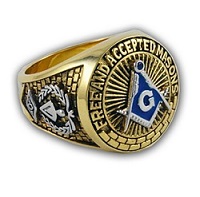
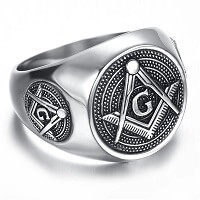
Last, but not least, you have learned that there is no such thing as an Entered Apprentice ring...only Masonic rings, which are worn after you have passed your 3rd degree, the Master Mason degree, and become a Master Mason.
Congratulations!
See? That wasn't so difficult, now was it?
If you don't feel you can remember it all, today, in one "gulp", come back
tomorrow and re-read this page and re-take the quiz.
Repeat as often as necessary until you feel you have a firm grip on your 24 inch
gauge in one hand and your common gavel in the other.
I hope you have enjoyed learning via my Fast Track Masonic Lodge Education as much as I have enjoyed helping you!
See you again, soon!
Simon
Simon-Sez:
If you have additional questions about Freemasonry which
you feel that this Entered Apprentice Mason Study Guide did not address, request the name of your lodge's Education Officer (many times this is your Senior Warden's duty) and speak to him for further clarification.
After you have finished this Entered Apprentice Mason Study Guide and completed your Entered Apprentice degree, I hope you will return to this Masonic Study Guide to continue your studies and encourage other members of the brethren to do the same.

Related Pages
The Foundational Importance of the Right Triangle in Freemasonry
Like It?
If you would like to share this Masonic education with your friends, it's easy to do.
Just click on the social media icons, below, to 'Like It' on FaceBook, or 'Tweet' it on Twitter.
5 Fast Methods To Find the Information You Want to Learn About
- Search Box - Use the Search Box at the top of your page.
- Site Map - Use my Site Map page to find the topics you are most interested in.
- Carousel - Use the carousel of pages at the top of your screen.
- Menu Icon - On MOBILE, click the MENU button at the top of each page.
- Masonic Books - Browse through a selection of Masonic books.

Questions and Answers About Freemasonry
The
Masonic Wife answers unspoken questions about the facts and myths surrounding Freemasonry.