47th Problem of Euclid
How To Square Your Square
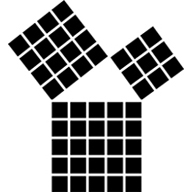
The 47th Problem of Euclid, also called the 47th Proposition of Euclid, or the Pythagorean Theorem, is represented by what appear to be 3 squares.
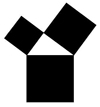
To non-Freemasons, the 47th Problem of Euclid may be somewhat mysterious. Most wonder at the significance of this strange looking, 3-box symbol on a piece of Masonic jewelry.
Most Masonic books, simply describe
it as "A general love of the Arts and Sciences". However, to leave its
explanation at that would be to omit a subject which is very important... not
only of Pythagoras's Theory, but of the Masonic Square.
What Are These 3 Black Boxes and Why Are They Important to Freemasons?
We are told that Euclid, (the Father of Geometry), who lived several hundred years after Pythagoras, worked long and hard to solve the 3:4:5: ratio puzzle. It is said by some that he then sacrificed a hecatomb (a sacrificial offering to God of up to 100 oxen or cattle). However, historically, it is believed that the Egyptians and Babylonians understood the mathematical usefulness of the 3:4:5 ratio long before Euclid.
The math is the key to understanding this symbol's broader and universal meaning.
The Pythagorean Theorem, also known as the
47th Problem of Euclid or 3:4:5:
"In any right triangle, the sum of the squares of the two sides is equal to the square of the hypotenuse." (the hypotenuse of a right triangle...which is the longest "leg"...or the 5 side of the 3:4:5:).
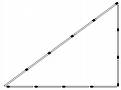
The Right Triangle, below, shows the sides of 3, 4 and 5. The angle created between the 3 (side) and the 4 (side) is the Right angle of the square.
A little later, when we begin to build it, (with sticks and string), you will place your sticks at the 3 corners of this Right triangle.
The square of 3 is 9.
The square of 4 is 16. The sum of 9 and 16 is 25. (25 represents the hypotenuse).
The square root of 25 is 5.
Therefore, the ratio is written: 3:4:5:
When we write down the square of the 1st four numbers (1, 4, 9 and 16), we see that by subtracting each square from the next one, we get 3, 5 and 7.
Ok, let's try it.
1, 4, 9, 16
4-1 =3
9-4 = 5
16-9 = 7
3:5:7: These are the steps in Masonry. They are the steps in the Winding Stair which leads to the Middle Chamber and they are the number of brethren which form the number of Master Masons necessary to open a lodge of:
Master Mason: 3
Fellow Craft: 5
Entered Apprentice: 7
These are the sacred numbers.
OK, stay with me now...the major math is over.
The essence of the Pythagorean Theorem (also called the 47th Problem of Euclid) is about the importance of establishing an architecturally true (correct) foundation based on use of the square.
Why is this so important to speculative Masons who only have a symbolic square and not the actual square (the tool) of an operative Mason?
The 47th Problem of Euclid is the mathematical ratio (the knowledge) that allows a Master Mason to:
"Square his square when it gets out of square."
...I heard that! You're saying to yourself: "Why is that so important to ME in today's world...unless I'm a carpenter? Home Depot is only a few miles away."
How to Create a Perfect Square using the 47th Problem of Euclid
The knowledge of how to form a perfect square without the slightest possibility of error has been accounted of the highest importance in the art of building from the time of the Harpedonaptae, (and before). Harpedonaptae, literally translated, means "rope stretchers" or "rope fasteners" of ancient Egypt (long before Solomon's Temple was built).
The Harpedonaptae were architectural specialists who were called in to lay out the foundation lines of buildings. They were highly skilled and relied on astronomy (the stars) as well as mathematical calculations in order to form perfect square angles for each building.
In the Berlin museum is a deed, written on leather, dating back to 2000 B.C. (long before Solomon's time), which tells of the work of these rope stretchers.
Historically, a building's cornerstone was laid at the northeast corner of the building. Why in the northeast?
The ancient builders first laid out the north and south lines by observation of the stars and the sun...especially the North Star, (Polaris), which they believed at that time to be fixed in the sky.
Only after laying out a perfect North and South line could they use the square to establish perfect East and West lines for their foundations.
The 47th Problem of Euclid established those true East and West lines, so the rope stretchers could ascertain a perfect 90 degree angle to the North/South line which they had established using the stars.
If you'd like to perform this yourself, it is actually quite easy...and once you get the necessary pieces together, would be a great "Show-and-Tell" educational instruction piece within your lodge.
The instructions are below, but it is easier to follow
the instructions in a step-by-step manner (with string and sticks in hand) than
it is to only read them for a complete understanding.
Better still, print numbers 1 through 4, below and then get your sticks and your
string ready.
When you finish, you, too, will probably cry "Eureka!", ...just as I did.
The 47th Problem of Euclid
Unlike the Harpedonaptae, you have no way to establish true North and South...unless you use a compass. But a compass isn't necessary for this demonstration.
However, you WILL be able to create a perfect square...with only sticks and string, just as our ancestors did.
You will need 4 thin sticks which are strong enough to stick them into soft soil, 40 inches of string and a black magic marker. Actually, any length will work, but this size is very manageable.
The larger the foundation which the Mason wished to build, naturally, the longer his rope (string) would have to be.
- Place your 1st
stick flat on the ground so that its ends point north and south.
- Next, take a string (it's much more unwieldy if
you use rope) and tie knots in it, 3 inches apart. This will
divide the string into 12 equal divisions.
- Tie the 2 ends of the string together
(this is your 12th knot) ...again ...remember that from knot-to-knot it must be 3 inches apart. The divisions between knots must be correct and
equal or it will not work.
- Your string's total length is 36".
After you've tied the end-to-end knot, you may cut off the excess 4" of string.
- If you have more than 4" of string
left or less than 4" of string left, you need to re-measure the lengths between your knots.
- Your string is now circular in shape and has 12 knots and 12 divisions between the knots. (see the Right Triangle, again, below)
Note: The Operative Masons of old, used rope, however, because much of the length of the rope is within the knot, if you use rope, you must use a longer piece, measure each division, tie your knot, and then measure your next 3 inch division before you cut the length of rope, instead of marking the entire rope while it is lying flat and then tying your knots.
- Stab your
2nd stick in the ground near either end of your North/South stick and arrange a knot at the stick.
- Stretch 3 divisions away from it in any direction (9 inches) and insert the 3rd stick in the ground, then...
- Place the 4th stick so that it falls on the knot between the 4-part and the 5-part division (12 inches).
This forces the creation of a 3:4:5:
right triangle. The angle between the 3 units and the 4 units is, of necessity, a square or right angle.
Now, move your 3rd and 4th sticks until they become a right angle (90 degrees) to your North/South stick.
Congratulations! You now have not only the ability to
square your square, but to lay a geometrically correct cornerstone for your new foundation!
However, usage of the 47th Problem of Euclid doesn't end here...
Here is the rest of the story...
The Forty-Seventh Problem of Euclid
in Today's World
With this simple geometric 3:4:5 ratio of how to create a 90 degree, Right Angle:
- Man can reach out into space and measure the
distance of the stars...in light years!
- He can survey land, mark off boundaries and
construct every single thing on Earth.
- He can build homes, churches and buildings, and
with the knowledge of this simple ratio...he can begin digging on opposite sides of a mountain and dig a straight tunnel through the center of it...that meets exactly at the center!
- The 47th Problem of Euclid represents such a perfect symbol of Freemasonry...encompassing both art and science, that the simple knowledge of it demands a breathtaking awe to which we may only bow our heads in reverence at the perfection, the universality and the infinite wisdom of that which has been given to us by God.
With the knowledge of this simple geometric ratio, (provided by the 47th Problem of Euclid), the word "Eureka!" almost palls in expressing the fundamental powers which our Creator has bestowed upon us!
...AND it all begins by simply learning how to Square your Square.
Oh!..., and one last thing you have also learned (but may not have realized it)...
This is why the old antique, wooden carpenter squares which you have seen or have heard about
have one longer leg.
Their "legs" were created using the "3" and "4" part of the 3:4:5 ratio (the 5 is the hypotenuse) using the 47th Problem of Euclid.
Equal length "legs" on modern day (carpenter) squares are relatively "new"
technology..
Now, take another look at the Masonic symbol for the 47th Problem of Euclid, above. You will see that the square on the top-left measures 3 units on each of its sides; the square on the top-right measures 4 units on each of its sides and the bottom square measures 5 units on each of its sides.
You can now see the right triangle (white space in the middle) which is surrounded by the 3 "boxes".
From this day forward, when you see this graphic image denoting the 47th Problem of Euclid,...this Masonic symbol, it will not just look like 3 odd-shaped black boxes to you. You will see the 3:4:5 ratio and the square (right angle) within them and know that you have the power to square your square within your own Middle Chamber.
...And THAT is the Rest of the Story!
Euclid's 47th Proposition Masonic Pin...for sale on Amazon


Related Pages
5 Fast Methods To Find the Information You Want to Learn About
- Search Box - Use the Search Box at the top of your page.
- Site Map - Use my Site Map page to find the topics you are most interested in.
- Carousel - Use the carousel of pages at the top of your screen.
- Menu Icon - On MOBILE, click the MENU button at the top of each page.
- Masonic Books - Browse through a selection of Masonic books.
Questions and Answers About Freemasonry
The
Masonic Wife answers unspoken questions about the facts and myths surrounding Freemasonry.